Middletown vs Newark DE Housing and Nearby Town Options
March 24, 2026
March 24, 2026
Trying to decide if Middletown or a nearby town fits your home search best? You are not alone. Many buyers weigh price, commute, lot size, and lifestyle before picking a neighborhood. In this guide, you will learn how Middletown compares with Newark, Bear, and Townsend so you can match your needs with the right area. Let’s dive in.
Middletown has grown quickly in recent decades. The town’s population is about 23,192 according to the 2020 Census, with a 2024 town estimate over 25,000. The average commute time is about 30 minutes, and the median value for owner-occupied homes is about $399,500. You can confirm these signals on U.S. Census QuickFacts for Middletown.
Newark is larger and more urban, with a population around 30,601 and a shorter mean commute near 19 minutes. Home values in the owner-occupied segment have a median around $382,500. Newark includes the University of Delaware and a denser downtown core.
Bear is a suburban community with a population of about 23,060. Owner-occupied median value sits around $280,200, which is often lower than Middletown or Newark. Many neighborhoods here grew during the 1980s through the 2000s.
Townsend is much smaller, with around 2,717 residents in 2020, and has a small-town, semi-rural feel compared with Middletown or Bear.
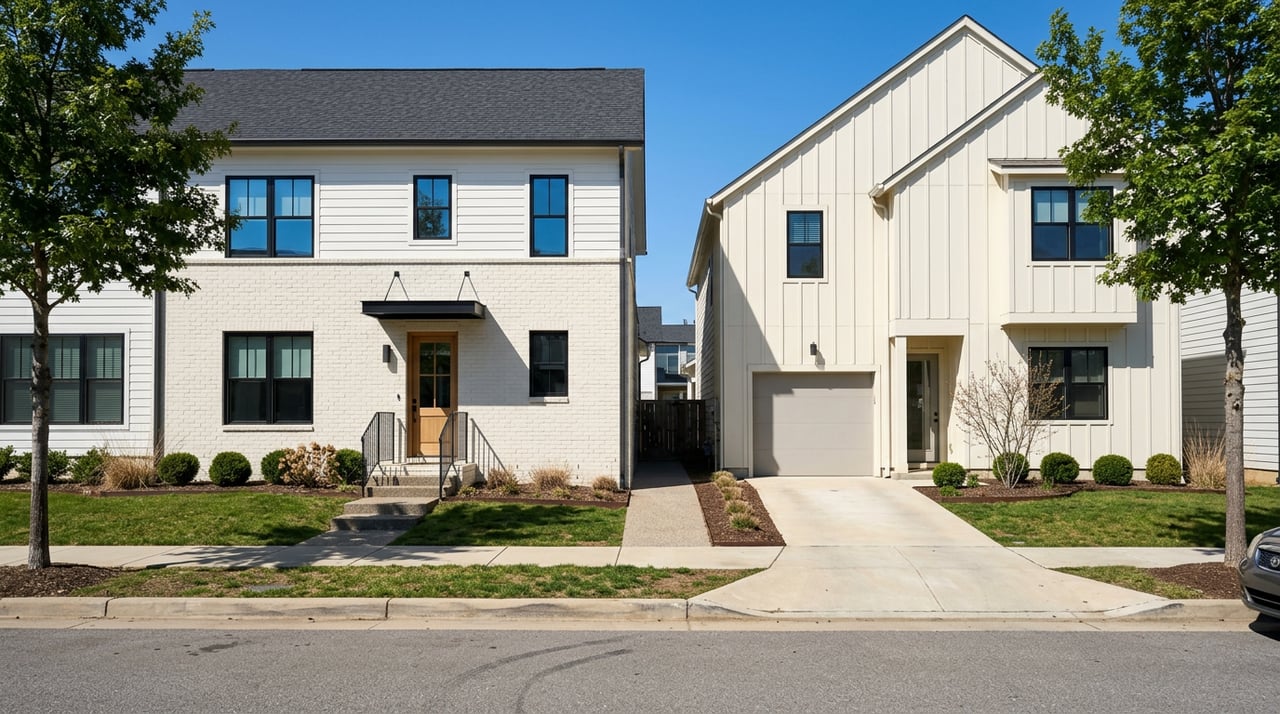
Middletown offers many single-family subdivisions built since the 1990s and 2000s, plus new construction options. You will also find townhomes and paired homes, along with a smaller historic core downtown. Newer subdivisions tend to have modest suburban lots, often in the ballpark of roughly 0.15 to 0.5 acres, with older in-town parcels smaller. Planning materials describe Middletown as a key growth area with expanding residential neighborhoods.
Newark’s housing mix reflects its university presence. Closer to downtown and the campus, you will find smaller-lot detached homes, rowhouses, and apartments. Farther from the core, neighborhoods shift to larger-lot single-family homes. The area has a higher share of rentals around the University of Delaware, which shapes the overall housing mix and density.
Bear’s housing stock is largely suburban single-family neighborhoods, many developed in the 1980s through the 2000s, plus some townhouse communities. Lots are typically suburban sized and often smaller than many outlying rural parcels. If you want a traditional subdivision setting with convenient road access, Bear offers broad options.
Townsend’s small-town center is surrounded by planned communities and semi-rural homes. You can find suburban-sized parcels in neighborhoods like Townsend Village as well as larger lots in outlying areas. Inventory is smaller and can vary widely month to month, so it pays to look block by block.
Commuting differences can be a deciding factor. Middletown’s mean commute time is about 30 minutes, reflecting that many residents drive north to Wilmington area jobs or south toward Kent County. Newark’s average commute is shorter at around 19 minutes, in part because more people live close to work or tap into local transit and campus-related jobs.
For specific destinations, mapping tools typically show about a half hour from Middletown to Newark in normal conditions. Always test your drive during peak hours to see real travel times.
If you want rail access, Newark and Wilmington offer the SEPTA Wilmington/Newark Regional Rail line with connections into the greater Philadelphia region. Amtrak also serves Wilmington and select Newark services. Check current schedules and parking before you plan your commute.
For Middletown and Townsend, bus service through DART First State connects parts of southern New Castle County and Kent County. Route 302 is an example that links the Middletown–Townsend–Dover corridor. These options can work for some commutes, though travel times are often longer than driving.
Middletown’s growth has been matched by school expansions in the local district. Newark and Bear are served within the Christina School District network. Townsend is smaller, so assignments depend on the exact address. Delaware also offers school choice options. Always confirm your exact school boundaries and choices using the district’s lookup tools before you decide on a home.
ChristianaCare is one of Delaware’s largest private employers, with major healthcare campuses in the Newark and Wilmington area. Many residents across Middletown, Newark, and Bear choose to live within a reasonable drive of those medical facilities and jobs.
The University of Delaware also shapes Newark’s economy, culture, and housing demand. Its campus anchors dining, retail, sports, and arts programming that residents from surrounding towns use as well.
Middletown combines an historic main street with newer shopping centers near the DE 1 corridor. Newark offers a walkable downtown with restaurants and university-driven events. Bear residents benefit from access to the Christiana Mall area and retail corridors nearby. Townsend is quieter with fewer big-box options, and many residents drive to Middletown or the Christiana corridor for larger shopping trips.
For parks, residents across these towns use regional options such as Lums Pond State Park and various county green spaces. Outdoor access is strong across southern New Castle County.
Use these quick profiles to focus your search:
Ready to zero in on the right fit and negotiate with confidence? Get local, data-backed guidance for Middletown, Newark, Bear, and Townsend with a friendly, no-pressure consult from Myking Johnson.
Stay up to date on the latest real estate trends.

When working with Myking, know that her time and expertise will be completely devoted to you. She will collaborate with you to keep you informed every step of the way until your home ownership objectives are met. Call her or send her an email to get started!
Get In Touch With Our Team To Learn More

Myking Johnson, Licensed in Delaware
Phone: (215) 531-2301
Office: (855) 450-0442
Email: [email protected]
Address: 200 Continental Dr. Ste 401 Newark, DE, 19713